 Hyper liquid
 order settings that control execution
Hyper liquid order settings control acceptable prices, immediate matching, remaining quantities, and changes to an existing position. Post-only prevents an order from taking liquidity on arrival. Immediate or cancel removes any quantity that cannot execute immediately, while good til canceled allows a remainder to wait. Reduce-only restricts position changes. A limit price can work with a time-in-force setting and reduce-only instructions to constrain price, timing, and exposure together.
Immediate execution, resting orders, and maker-only placement
A market order seeks immediate execution against available liquidity, while a limit order sets the least favorable price acceptable for its fills. A buy limit caps the purchase price; a sell limit sets a minimum sale price.
A limit order can still execute immediately when its price reaches available opposing orders. Selecting a limit price alone does not require maker execution.
Good til canceled, or GTC, allows unfilled quantity to remain on the book. Immediate or cancel, or IOC, removes the unfilled remainder after the immediate execution attempt. An IOC can therefore execute partially without leaving another order waiting.
Add liquidity only, or ALO, is the post-only option. It cancels an order that would match immediately. The choice trades immediate execution for the requirement to enter as resting liquidity. The book can move between preparation and processing, so a previously non-crossing price may no longer qualify.
Preparing a post-only order before submission
You can revise or discard the draft until you submit the order. Post-only does not create a review period after acceptance: another order can subsequently trade against it.
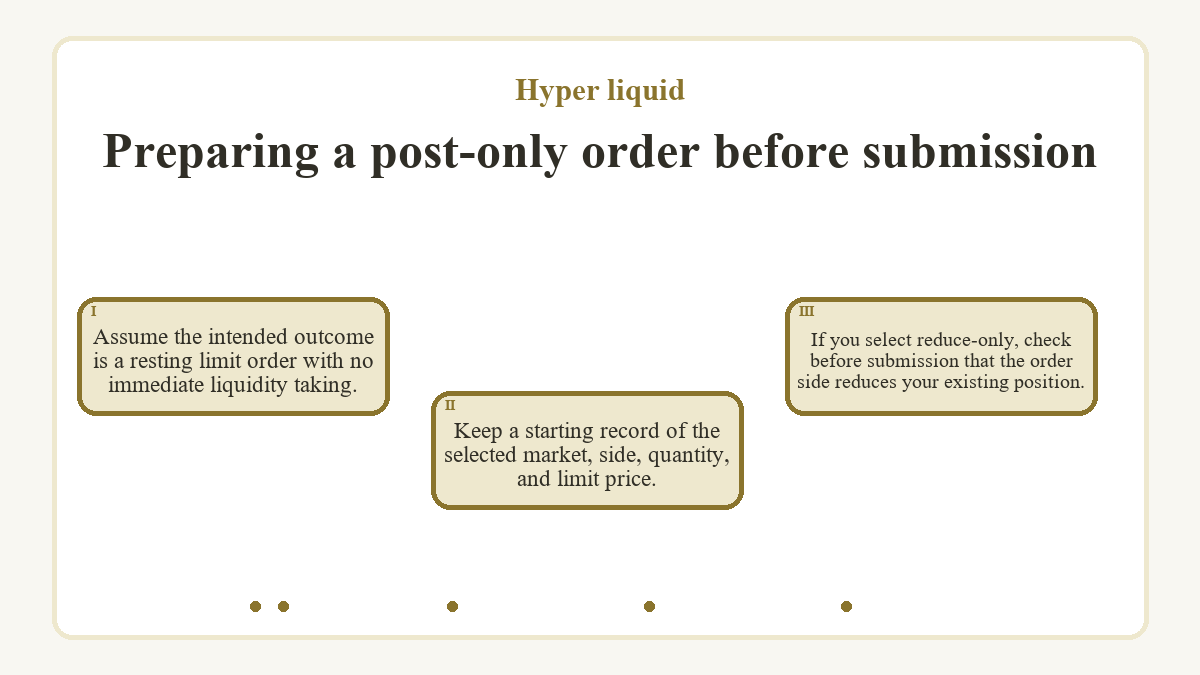
Assume the intended outcome is a resting limit order with no immediate liquidity taking. Keep a starting record of the selected market, side, quantity, and limit price. If you select reduce-only, check before submission that the order side reduces your existing position.
- If immediate matching is unacceptable, select post-only rather than relying on the displayed spread.
- If the draft remains unsubmitted, revise or discard it before authorizing the order.
- If submission returns a resting order identifier, use it to check the order’s status and compare its market, side, remaining quantity, and limit price with the draft.
- If the response rejects immediate matching, reassess the price before submitting another instruction.
- If fills appear after acceptance, treat that quantity as executed; cancellation only addresses the remaining order.
The post-only rule stays the same while the opposing book changes. A resting response establishes acceptance at that moment. Subsequent fills invalidate the assumption that the entire quantity remains available to cancel.
Price priority and margin constrain resting orders
A resting limit order needs matching liquidity and sufficient priority to fill; reaching its price alone does not establish complete execution. Orders match by price-time priority. Earlier orders at the same price stand ahead. For perpetual orders, margin checks also occur when opening an order and when a resting order matches. Acceptance therefore does not reserve future execution regardless of changing account conditions.
Reduce-only constrains the resulting position
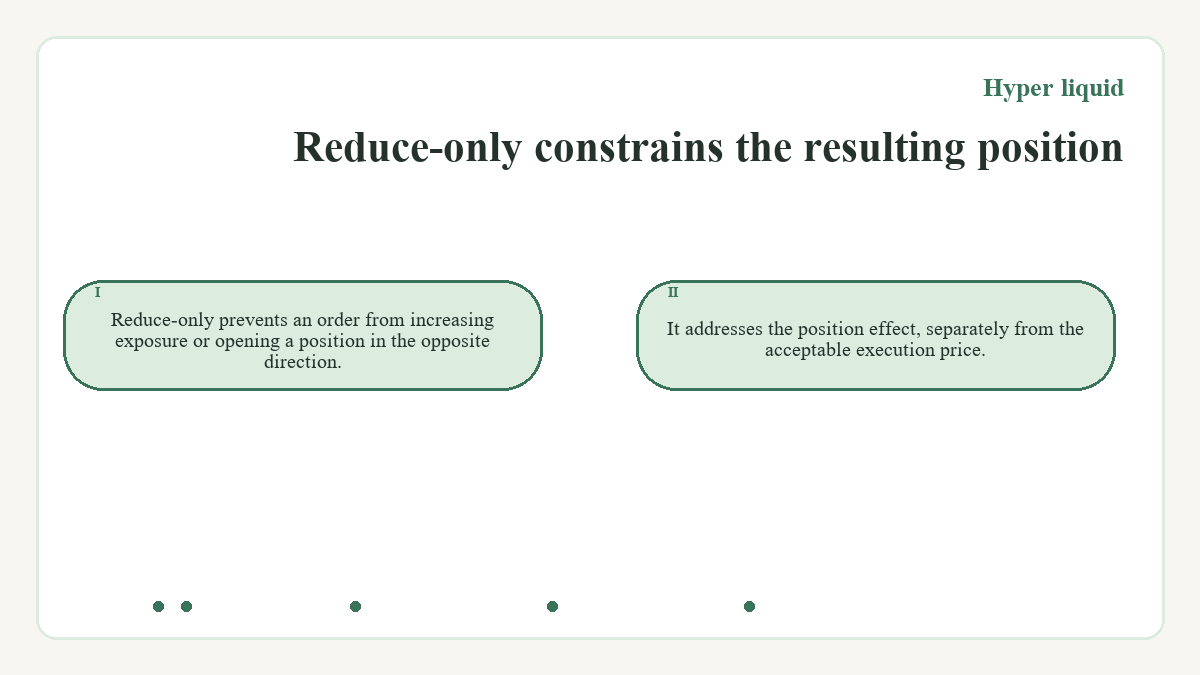
Reduce-only prevents an order from increasing exposure or opening a position in the opposite direction. It addresses the position effect, separately from the acceptable execution price.
A closing instruction needs the correct side relative to the existing position. Other fills can change that position before the instruction executes. The exchange rejects a reduce-only order that would increase it. A price control cannot repair an incompatible position instruction, and a reduce-only flag does not guarantee available liquidity.
Does a stop-limit order guarantee an exit?
A stop-limit order can remain unfilled after activation when available opposing prices fall outside its limit. The trigger determines activation; the limit determines acceptable execution.
For take-profit and stop-loss orders, the mark price supplies the trigger. A sell limit can remain above available bids after a sharp decline. Moving its limit lower admits less favorable execution prices, while retaining a tighter boundary increases the possibility of waiting.
A market TP/SL seeks execution after activation within its applicable slippage tolerance. Neither the trigger price nor the order label promises the final fill price.
Attached exits and position exits have different dependencies
Take-profit and stop-loss instructions attached to an entry have a fixed size equal to the parent order, and their placement depends on its outcome. Position-level exits instead address an existing position, with different sizing behavior.
Attached exits are placed when the parent fully fills and then await their price triggers. While the parent remains open and incompletely filled, its attached exits remain unplaced.
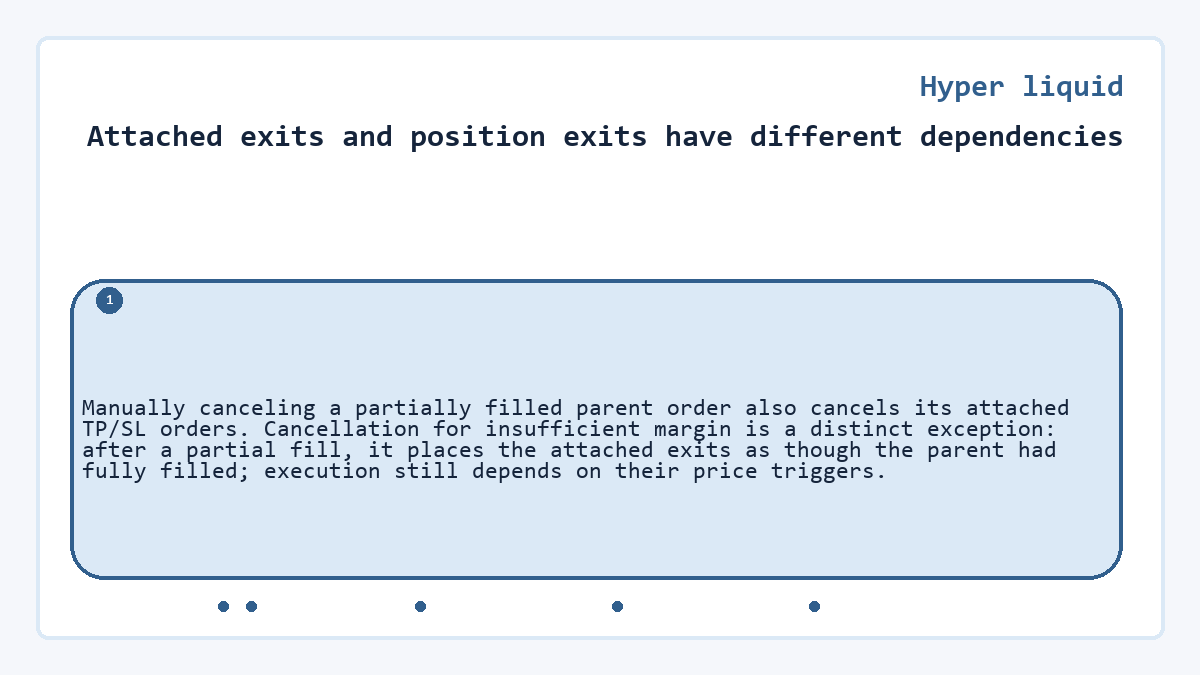
Manually canceling a partially filled parent order also cancels its attached TP/SL orders. Cancellation for insufficient margin is a distinct exception: after a partial fill, it places the attached exits as though the parent had fully filled; execution still depends on their price triggers.
Position-level TP/SL without an explicitly configured size attempts to close the entire position at activation. Setting a specific quantity makes the order fixed-sized. Later position changes therefore affect these alternatives differently.
Scale, TWAP, and chase distribute execution differently
Scale distributes limit orders across a price range. Time-weighted average price, or TWAP, distributes execution attempts over time. Chase repeatedly adjusts a post-only limit order near the best bid or ask. These settings change where or when orders compete for execution.
TWAP timing depends on total size and running time. Its optional randomization changes suborder sizes; a trigger price delays activation, and a maximum or minimum stop price terminates execution when the mark price reaches it. Market conditions and suborder slippage constraints still limit fills.
Chase follows changing quotes, so its price can move during operation. A fixed limit retains the submitted price boundary, while scale places separate limits across the selected range. The relevant distinction is whether the instruction should follow quotes, wait at chosen prices, or attempt execution over time.
What to know about Hyper liquid
-
Can a chase order keep repricing after its browser tab closes?
- Chase automation runs in the browser tab where the order was created. Continued repricing therefore depends on that tab remaining operational. Closing the tab does not establish that any existing resting order has been canceled; its exchange status requires a separate check.
-
Why does dragging a TP/SL marker sometimes produce an error?
- Dragging a TP/SL marker to a level that would cause immediate execution produces an error. The chart interaction prevents that adjustment. An intentional immediate close uses the position table or order form instead.
-
How does price precision affect an otherwise valid limit order?
- A limit price must satisfy the market’s accepted precision rules. Price precision depends partly on the asset’s size precision, and integer prices receive a separate allowance. Size also has an asset-specific decimal limit. Extra decimal places can therefore invalidate an instruction even when its direction and intended price are reasonable.
-
What happens when an incoming order would match another order from the same address?
- Self-trade prevention cancels the resting order instead of producing a self-trade. That cancellation incurs no trading fee and does not appear as a trade in the trade feed. The incoming order may continue matching other available liquidity within its price limit.
-
Is available collateral enough to guarantee acceptance of a new perpetual order?
- Available collateral does not override other order constraints. An instruction can encounter open-interest restrictions, a position limit associated with its margin tier and leverage, or a price too far from the oracle. The rejection reason identifies which condition prevented placement.