 Hyper liquid
 spot and perpetual trading choices
Hyper liquid is a layer 1 blockchain for spot token purchases and perpetual derivatives traded through onchain order books. Spot trading exchanges token balances, while perpetuals provide long or short exposure backed by collateral. Both depend on available orders for execution. The main differences concern ownership, collateral use, ongoing costs, and liquidation risk. Account settings also matter because some modes share balances across activities or allow borrowing against eligible assets.
HyperCore trading and HyperEVM applications
HyperCore runs the native spot and perpetual order books, while HyperEVM supports general-purpose smart contracts on the same blockchain. Both use HyperBFT consensus. Direct trading involves balances, orders, and positions on HyperCore. HyperEVM lets applications interact with trading infrastructure through supported mechanisms, including CoreWriter actions and precompiles that read chain state. This connection supports applications with their own accounting and controls, alongside direct access to the order books.
Sharing a blockchain does not make every application balance immediately available for a native order.
Spot ownership and perpetual exposure
Buying and selling token balances
A spot fill exchanges the pair’s base and quote assets. A purchase increases the acquired token balance, subject to fees; a sale reduces it. Fully paid spot holdings outside borrowing or collateral arrangements do not require perpetual maintenance margin. Their market value can still fall, and selling depends on available buyers. Holding a token also differs from holding a derivative tracking its price, especially when transferability or use in an application matters.
Opening a derivative position
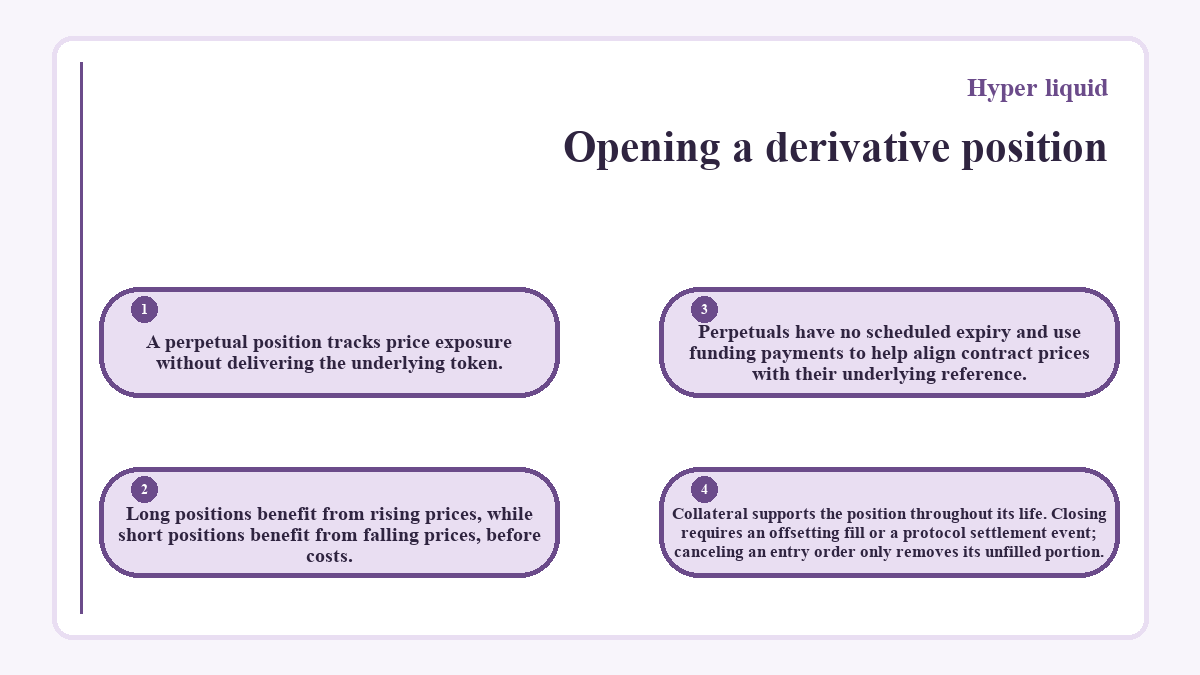
A perpetual position tracks price exposure without delivering the underlying token. Long positions benefit from rising prices, while short positions benefit from falling prices, before costs. Perpetuals have no scheduled expiry and use funding payments to help align contract prices with their underlying reference. Collateral supports the position throughout its life. Closing requires an offsetting fill or a protocol settlement event; canceling an entry order only removes its unfilled portion.
Price-time priority and available liquidity
Orders match by price-time priority: better prices take precedence, followed by earlier orders at the same price. Each market also specifies valid price increments and order-size increments. A limit order sets an acceptable execution boundary, but reaching its price does not guarantee a complete fill. Other orders may stand ahead of it, or the available opposing quantity may cover only part of its size.
A displayed quote describes available liquidity at that moment. Execution can change as orders enter, fill, or disappear.
Marketable orders consume resting liquidity and may execute across several price levels. That makes order size relative to book depth relevant to slippage. A resting limit order preserves its price boundary while accepting the possibility of waiting or remaining unfilled. These choices affect execution certainty differently: a tighter price condition restricts acceptable trades, while more aggressive pricing can reach additional liquidity at a less favorable price.
Deposits and the balance available for trading
Traders can connect an EVM wallet or use email login where the selected interface supports it. Funding routes can credit collateral directly or deliver a spot asset requiring conversion before another market accepts it. The selected asset, network, and destination must match the route. A balance on HyperEVM and a balance on HyperCore occupy different parts of the chain, so a supported transfer may be necessary before trading.
A deposit confirmation establishes receipt, but the account’s balance arrangement determines where those funds support orders. Standard mode separates spot and perpetual balances, including separate perpetual exchange balances. Unified mode combines each asset’s spot balance with its use as collateral for supported cross margin positions. This distinction explains why a visible total balance can differ from the amount available for a particular order or withdrawal.
Collateral sharing across account modes
Cross margin and unified balances
Cross margin shares collateral across the positions within its permitted scope. In standard mode, that scope stays within an individual perpetual exchange. Unified accounts can share collateral across supported cross margin positions using the same collateral asset. Losses therefore affect the shared pool supporting other positions. Greater capital reuse comes with greater interaction between trades, rather than a separate loss allowance for every position.
Isolated positions and portfolio borrowing
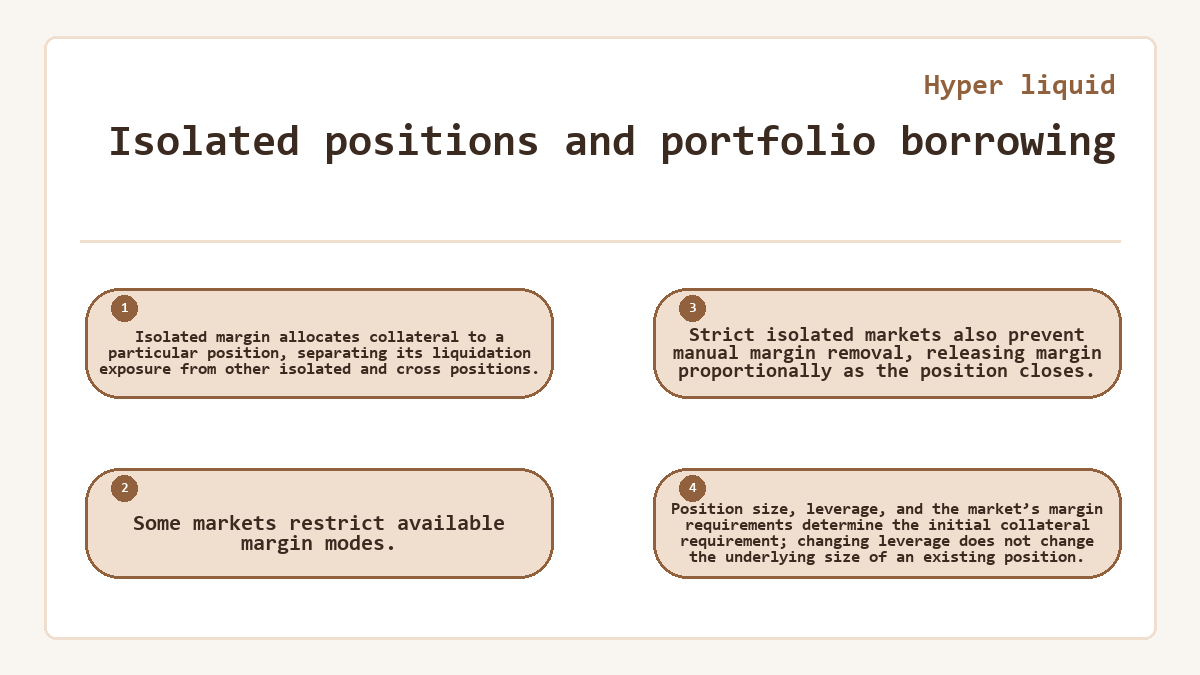
Isolated margin allocates collateral to a particular position, separating its liquidation exposure from other isolated and cross positions. Some markets restrict available margin modes. Strict isolated markets also prevent manual margin removal, releasing margin proportionally as the position closes. Position size, leverage, and the market’s margin requirements determine the initial collateral requirement; changing leverage does not change the underlying size of an existing position.
Portfolio margin connects eligible spot assets and perpetual exposure more broadly. Insufficient settlement balances can trigger borrowing against eligible collateral, creating interest costs and portfolio liquidation exposure. Eligibility requirements and supply or borrow caps constrain this mode. When borrowing caps bind, additional margin must come from the settlement asset. Consequently, a spot balance participating in portfolio collateral should not be assessed like an unencumbered, fully paid holding.
Trading charges and the cost of holding exposure
Trading costs depend on the market, executed value, maker or taker status, and applicable account fee tier. Spot and perpetuals use different schedules, although their trading volumes contribute to the account’s fee tier. Staking discounts and market-specific adjustments can also affect charges. An interface may add an approved builder fee, so the account’s base rate alone may not describe the full charge on a fill.
Perpetual funding is a separate transfer between position holders. A positive rate means longs pay shorts; a negative rate reverses that direction. The applicable position and funding rate determine the payment, so holding exposure can cost or earn funding independently of trading profit. Borrowing interest adds another cost when portfolio margin creates debt. Deposits, withdrawals, and HyperEVM transactions can introduce route-specific charges or gas costs outside the trading fee.
What can trigger liquidation?
Liquidation becomes possible when the relevant account or position no longer meets its maintenance margin requirement. Adverse price movements reduce equity, while collateral sharing determines which balances absorb that change. Perpetual liquidations use the mark price. This valuation can differ from the latest traded price, particularly during volatility, so a chart’s last trade alone does not describe proximity to liquidation.
Ordinary perpetual liquidation first attempts to close exposure through the order book. A backstop can take over when the applicable conditions require it. Portfolio borrowing has its own account-level liquidation process. These mechanisms can remove positions and collateral, including balances supporting more than one trade. An isolated allocation limits which collateral supports its position, while cross and portfolio arrangements connect a broader set of exposures.
A stop order adds an exit condition. It does not guarantee execution before liquidation.
A partial spot sale with the remainder canceled
A partial fill leaves a smaller token holding and, for a resting order, an outstanding remainder. Consider a hypothetical spot sale of 124 token units. Assume the market permits the quantities, the order meets its minimum value requirement, and 79 units fill before the seller needs to stop waiting. All quantities and execution conditions in this example are hypothetical.
The unfilled quantity is 124 minus 79, or 45 units. Only the executed portion generates trading charges. Its proceeds depend on the fill prices and applicable fees; the submitted limit alone does not establish net proceeds.
The seller requests cancellation of the remainder, then checks the final order status and fill history. Cancellation can race with another fill. For this example, assume cancellation succeeds before any additional execution.
The completed record shows 79 units sold and 45 units canceled. The holding falls by 79 units. If P represents the hypothetical average fill price and F represents all applicable fees in the quote asset, net proceeds equal 79 × P − F. No remainder stays open. Selling the remaining tokens later would require another order under the prices and costs then available.
Reconciling fills, positions, and withdrawals
Fill history establishes executed size and price; open orders show outstanding commitments. The position or token balance records the resulting exposure. Comparing these records prevents a submitted order from being mistaken for a completed trade. For perpetuals, realized profit or loss, funding, fees, and transfers can all change the balance. Unrealized profit remains linked to an open position and should not be treated as completed sale proceeds.
An exit also requires distinguishing position closure from moving funds. Reduce-only orders restrict execution to reducing a perpetual position. A withdrawal depends on the remaining collateral requirements and the chosen transfer route. Sending tokens to another account on HyperCore differs from withdrawing them to another blockchain. The relevant completion record is the destination credit on the intended network, alongside the withdrawal status, rather than the disappearance of funds from the trading balance.
Builder markets, vaults, and HYPE staking
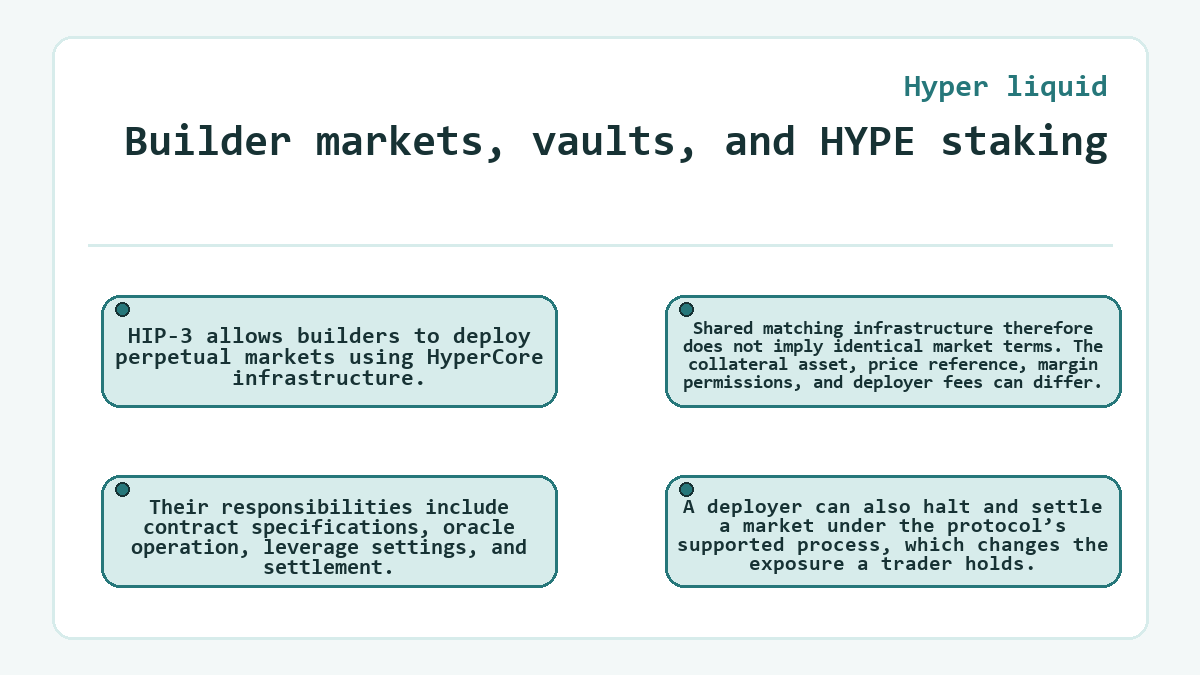
HIP-3 allows builders to deploy perpetual markets using HyperCore infrastructure. Their responsibilities include contract specifications, oracle operation, leverage settings, and settlement. Shared matching infrastructure therefore does not imply identical market terms. The collateral asset, price reference, margin permissions, and deployer fees can differ. A deployer can also halt and settle a market under the protocol’s supported process, which changes the exposure a trader holds.
Vaults introduce another arrangement: funds participate in a strategy rather than individual trades chosen directly by the depositor. HyperEVM vaults can use customizable accounting and supported HyperCore interactions. Legacy HyperCore vaults do not support spot or HIP-3 trading; HyperEVM vaults can support both. Strategy behavior and withdrawal conditions belong to the particular vault, and trading losses can affect its value.
HYPE also supports validator staking within HyperCore. Delegation participates in network security and earns rewards subject to validator operation and commission. Staking has withdrawal timing constraints, unlike simply holding an available spot balance. These functions sit alongside trading, but they create different commitments: a token holding, a derivative position, a vault allocation, and a staking balance do not have interchangeable exit conditions.
Direct orders and application-mediated trading
Direct spot trading fits an intended token acquisition or sale. Perpetuals provide long or short exposure with margin and ongoing funding obligations. An application can combine these operations with lending or vault accounting, adding its own contract behavior and permissions. HyperEVM uses HYPE for gas, whereas native order-book trading does not require a separate gas payment for each trade. Application access therefore has a different cost and authorization profile.
Onchain execution also makes trading activity observable. Wallet control does not make orders or positions private, and connecting an address to an identity can expose associated activity. Direct trading leaves order selection with the account operator; a vault or automated application delegates some decisions to its strategy or code. These routes differ in the exposure acquired, control over collateral and exit, and execution costs.
Fully paid spot ownership avoids perpetual funding, while derivatives add short exposure and leverage with continuing collateral obligations.
Hyper liquid FAQ
Why can a post-only order disappear without a fill?
A post-only order cancels if it would immediately match an existing order. This setting permits execution only as resting liquidity. A price change before the order reaches the book can therefore prevent it from resting. The canceled status indicates the order did not remain available for later execution; it does not establish that the requested trade occurred.
Can a TWAP finish without executing its full requested size?
A time-weighted average price order can finish with less than its requested quantity executed. Its suborders face liquidity and slippage constraints. Later suborders can attempt to catch up, but those attempts also have limits. Ending the scheduled run therefore does not prove full execution. The aggregate filled quantity establishes how much exposure the order actually changed.
Which price activates a take-profit or stop-loss order?
The mark price activates perpetual take-profit and stop-loss orders. The trigger price and eventual execution price serve different purposes. A triggered market order still faces execution conditions, while a triggered limit order requires liquidity within its limit. A sudden move can leave a limit order unfilled even after the mark price crosses its trigger.
Does a matching token name prove two spot assets are identical?
A matching displayed name does not establish identical token identity. Native token names need not be unique, and interfaces can display names differently from the underlying identifiers. The token identifier and any associated contract mapping establish which asset a balance represents. Those details matter when comparing listings or determining whether a transfer destination supports the asset.
How can an API query return no balance for an active trading account?
Querying an agent wallet address instead of the trading account can return an empty result. An API wallet signs authorized actions, while balances and positions belong to the master account or relevant subaccount. Balance queries must use that account’s address. In unified and portfolio modes, balance interpretation also requires the spot clearinghouse state rather than an isolated perpetual exchange balance.
Is HYPE required for every native spot or perpetual trade?
Native HyperCore spot and perpetual trading does not require HYPE gas for each order. Trading fees still apply to fills. HYPE serves a separate gas role on HyperEVM, and transfers between HyperCore and HyperEVM can also incur HYPE charges. The requirement therefore follows the operation being performed, rather than the mere presence of a trading account.